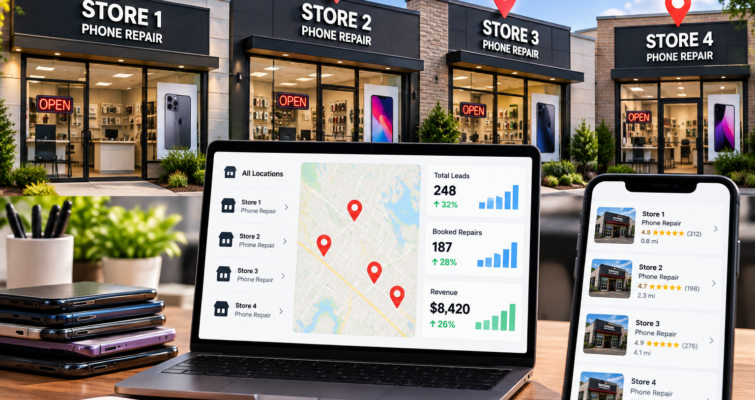
A multi-location repair business cannot market every store as if it were the same location copied several times. Each branch serves a different local market, competes with different nearby businesses, and may attract customers searching for different repair services. At the same time, the company still needs one consistent brand.
The strongest strategy combines centralized brand control with store-level local marketing. Each real location should have accurate business information, its own local landing page, a properly managed Google Business Profile, location-specific reviews and reporting, and advertising that reflects the services and demand around that store.
The goal is not to create dozens of near-duplicate pages. It is to give every legitimate store enough local relevance to compete while keeping the overall marketing system efficient.
Give Every Real Store Its Own Location Page
A staffed repair location with its own address, hours, phone number, and customer experience should normally have a dedicated page on the website. That page gives customers a clear destination for information about the branch and gives search engines a stronger local reference point.
A good location page should include the correct business name, address, phone number, hours, location context, services available at that store, real photos when possible, and a clear way to call, request a quote, or book.
The page should not simply duplicate another store page and swap the city name. If one branch offers microsoldering, data recovery, console repair, or another specialized service that another location does not, the website should make that difference clear.
Repair Max Marketing’s guide on when repair services and locations need separate pages explains why real search intent and real locations should determine the site structure.
Manage a Separate Google Business Profile for Each Eligible Store
Each eligible storefront should have its own Google Business Profile tied to the real location. Categories, services, hours, phone numbers, photos, and the website link should reflect that branch rather than simply copying the main store.
Linking each profile to its matching location page can create a clearer customer journey when several stores exist. A complete Google Business Profile optimization should also keep the website and profile aligned. Conflicting hours, phone numbers, or addresses create confusion for customers and search engines.
Keep NAP Information Consistent by Location
Name, address, and phone information should be consistent for each branch across the website, Google Business Profile, directories, social profiles, mapping platforms, and other important citations.
Multi-location businesses are more vulnerable to citation errors because information can easily cross between stores. An old number may remain attached to one location, a directory may show the wrong suite number, or two branches may be accidentally merged.
Accurate citations reinforce the identity of each store and reduce customer confusion. The article on reviews and local citations for repair shop rankings explains why accuracy and consistency matter more than building large numbers of weak listings.
Build Reviews Around the Store That Performed the Repair
Reviews should support the location where the customer actually received service. A customer who visited Store A should be directed to Store A’s review profile rather than a different branch.
That keeps reputation signals relevant to the correct market and gives future customers a more accurate picture of the store they may visit.
Each location should have a consistent process for requesting honest feedback after completed repairs. Staff should not script reviews or pressure customers to include specific keywords. Responses should be professional, useful, and specific to the actual experience.
Localize Service Priorities Without Fragmenting the Brand
Not every store needs identical marketing priorities. One branch may see stronger demand for iPhone repair, another may generate more computer work, and another may attract more console or data recovery customers.
The core brand can remain consistent while local content and campaigns emphasize what performs best in each market. A strong Local SEO strategy should combine company-wide standards with branch-level keyword research, competitor analysis, and service demand.
Avoid creating separate versions of every service page for every city unless those pages provide meaningful local value. In many cases, central service pages supported by strong location pages are cleaner than dozens of nearly identical service-and-city combinations.
Use Google Ads Budgets and Targeting by Store
Paid search should reflect the geography and economics of each branch. Two stores should not unknowingly compete for the same customers, and a location should not spend heavily in an area another branch serves more efficiently.
A Google Ads strategy for repair shops can separate targeting where necessary so budgets, keywords, landing pages, and conversion results can be evaluated by store.
This may reveal that one location performs well for iPhone screen repair while another generates stronger returns from MacBook or console repair. Budgets can then follow profitable demand rather than being divided equally without evidence.
Make It Easy for Mobile Visitors to Reach the Correct Store
Many repair customers search on a phone while they are already near the area they want to visit. The website should make it easy to identify the correct branch, call the right number, get directions, and see accurate hours.
A strong repair shop website should make location selection simple without forcing visitors through several menus. If quoting or booking is available, the customer should know which store will receive the request before submitting it.
Track Leads and Revenue by Location
Multi-location marketing becomes difficult to manage when all leads are pooled together. The business should be able to identify which store generated the inquiry, which marketing source produced it, and whether the lead became a paying repair job.
A repair shop CRM can help organize leads by location and source while keeping follow-up consistent across the company. Calls, forms, quote requests, appointments, and completed jobs can then be compared by branch.
A location with high lead volume but low booking rates may have a follow-up or staffing problem. Another may receive fewer leads but convert a much higher percentage into profitable repairs.
Centralize Standards, but Keep Each Store Locally Relevant
The brand should control the elements that need consistency: visual identity, messaging standards, website quality, tracking rules, review policies, service naming, and customer communication.
Each store should still reflect real local differences such as staff, services, photos, hours, neighborhood context, promotions, and customer demand. This supports E-E-A-T because the website and profiles represent real locations and real experiences rather than mass-produced local content.
Build a Multi-Location System That Can Scale
The best multi-location repair strategy is one coordinated system in which every real store has enough local relevance to compete and enough shared infrastructure to remain manageable.
That means dedicated location pages, individual Google Business Profiles, accurate citations, store-level reviews, sensible service targeting, location-aware advertising, mobile conversion paths, and reporting that connects leads to completed jobs.
Repair Max Marketing helps electronics repair businesses connect these pieces through websites, Local SEO, Google Ads, CRM systems, and conversion tracking built around the repair customer journey.
Contact Repair Max Marketing to review how each repair location is being marketed and where stronger store-level SEO, advertising, or lead tracking could improve performance.