Yes, these channels can work much better together than they do in isolation, but that does not mean every repair shop should activate everything at once. The right marketing stack depends on the shop’s service mix, budget, lead volume, location, and ability to respond quickly to new customers.
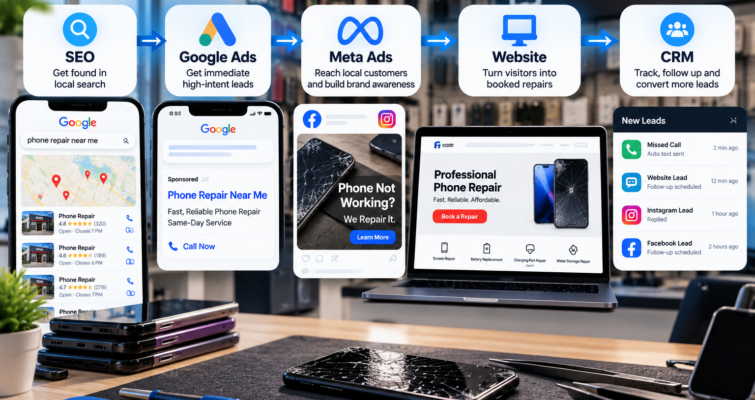
For an electronics repair business, the strongest system connects five jobs: getting found, creating demand, converting visitors, following up with leads, and measuring which marketing becomes paying repair work. Local SEO, Google Ads, Meta Ads, a website, and CRM each support a different part of that process.
The Website Should Be the Conversion Hub
Before adding more traffic, the repair shop needs somewhere strong to send it. A website should clearly explain what the business repairs, where it is located, why customers should trust it, and what they should do next.
A conversion-focused repair shop website can support service pages, tap-to-call actions, quote requests, booking, location information, reviews, and mobile usability. It also becomes the destination for organic and paid campaigns.
If the website is slow, unclear, or difficult to use on a phone, more traffic may simply expose more people to a weak conversion experience.
Local SEO Builds Long-Term Search Visibility
Local SEO helps a repair business earn visibility when nearby customers search Google Search and Maps for phone repair, computer repair, data recovery, console repair, and other services.
A strong Local SEO strategy connects the website with Google Business Profile optimization, relevant service pages, reviews, citations, accurate business information, and local authority.
SEO generally takes longer than paid advertising to develop, but strong visibility can compound over time. That makes it useful for building a more durable source of local demand instead of depending entirely on paid clicks.
Google Ads Captures Immediate Search Demand
Google Ads fills a different role. It can place the repair shop in front of people who are already searching for a service now.
A well-structured Google Ads campaign for repair shops should target services the business actually wants more of and connect keywords, geography, ad copy, and landing pages around the same intent.
This makes paid search useful when a shop wants faster demand while SEO is developing or when it wants to push specific profitable services. The important metric is not clicks, but whether those clicks become calls, quotes, appointments, and completed repairs.
Meta Ads Can Create Demand and Retarget Customers
Meta Ads work differently because customers are usually not actively searching Facebook or Instagram for a repair shop. The platform is better at building awareness, promoting visual offers, retargeting interested people, and supporting device buyback or resale campaigns.
A Meta Ads strategy can help the shop reach local audiences with repair offers, device trade-ins, refurbished inventory, or retargeting messages.
Google often captures existing intent. Meta can create or re-engage demand. The offer, creative, audience, and follow-up process should reflect that difference.
CRM Connects Leads to Follow-Up
Generating leads is only useful if the shop responds and knows what happened next. Calls can be missed, quote requests can sit unanswered, and customers can disappear after asking for a price.
A repair shop CRM can organize leads from calls, forms, texts, ads, and quote requests in one place. It can also support missed-call text-back, follow-up reminders, appointment communication, review requests, and lead-stage tracking.
That gives the shop a better chance of recovering opportunities and creates a clearer connection between marketing activity and real repair outcomes.
Why These Channels Work Better Together
A customer may first see a Meta ad, later search the business name on Google, read reviews, visit a service page, request a quote, receive a follow-up text, and finally book a repair. Another customer may discover the shop in Google Maps and call immediately.
When each channel is managed separately, those journeys are harder to understand. When the website, SEO, ads, and CRM are aligned, the shop gets a clearer view of how customers move from discovery to completed repair.
This is the same principle behind a complete repair shop marketing funnel: each stage should support the next rather than operate as a disconnected tactic.
A Shop Does Not Need to Launch Everything at Once
Integration does not mean buying every marketing service on day one. A shop with a weak website, missed calls, and no lead tracking may need to fix those problems before adding more advertising.
A practical sequence is often to strengthen the website and conversion tracking, establish reliable lead management, then build demand through Local SEO and the paid channels that best match the business.
A shop that urgently needs repair leads may prioritize Google Ads earlier. A business focused on device buybacks or refurbished inventory may find Meta Ads more useful. Local SEO should remain part of the long-term plan because organic visibility takes time to build.
The sequence should follow the bottleneck. If the shop already gets plenty of leads but fails to answer or follow up, buying more traffic is not the first problem to solve.
Use the Same Service Priorities Across the System
If the shop wants more data recovery, MacBook repair, console repair, or iPhone screen jobs, that priority should influence the website, SEO content, paid keywords, Meta offers, CRM tagging, and reporting.
This creates cleaner messaging and makes it easier to see whether a service is profitable across several channels rather than judging each platform by surface-level metrics.
A service receiving traffic but few completed jobs may need a landing-page, pricing, or follow-up review. A service that converts well but gets little visibility may deserve more SEO or advertising support.
Measure Paying Jobs, Not Just Marketing Activity
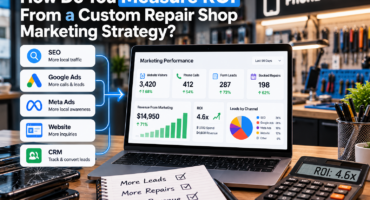
A connected marketing system should be judged by business outcomes. Impressions, clicks, rankings, reach, and lead volume are useful diagnostic metrics, but they are not the finish line.
Track calls, forms, quote requests, booked appointments, show-up rates, approved repairs, completed jobs, average ticket value, and revenue when the data is reliable.
That makes it possible to compare lead quality and customer acquisition cost across SEO, Google Ads, Meta Ads, and other sources. It also helps identify whether a problem exists before the lead arrives or during follow-up and sales.
Build One System Instead of Five Separate Channels
SEO, Google Ads, Meta Ads, a website, and CRM can create a strong growth system when each tool has a clear role and they share the same business priorities.
The website converts. Local SEO builds durable visibility. Google Ads captures immediate search demand. Meta Ads creates and retargets demand. The CRM keeps leads organized, supports follow-up, and helps connect marketing to completed repair jobs.
The goal is not to use more tools for the sake of complexity. It is to remove gaps between discovery, lead capture, follow-up, and revenue.
Repair Max Marketing works specifically with electronics repair businesses and connects websites, Local SEO, Google Ads, Meta Ads, and CRM systems around the repair customer journey.
Contact Repair Max Marketing to review which parts of your marketing system should be combined now, which should come next, and where your shop may be losing opportunities.