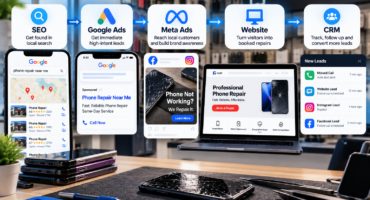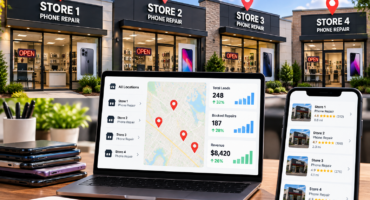
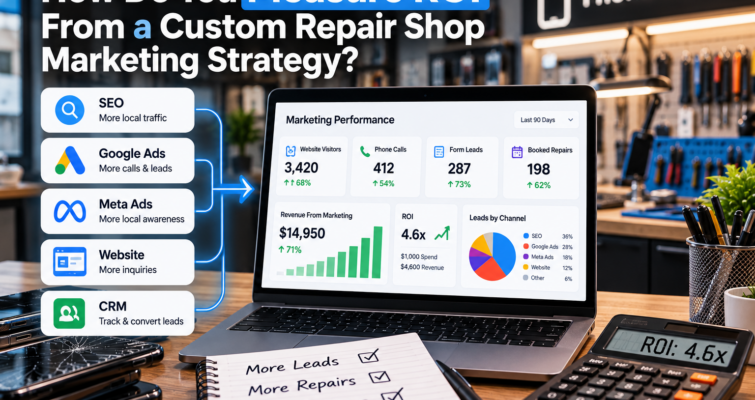
A custom repair shop marketing strategy should be measured by the business it creates, not just by clicks, rankings, impressions, or lead counts. Those metrics help explain performance, but return on investment becomes meaningful when marketing can be connected to booked repairs, completed jobs, revenue, and profit.
For electronics repair businesses, that connection is not always simple. A customer may discover the shop through Google Maps, return later through organic search, click an ad, request a quote, receive a follow-up text, and finally walk into the store. Measuring ROI therefore requires tracking more than one dashboard.
The goal is to understand which services and channels are producing profitable repair work.
Start With the Business Outcome You Want
Before calculating ROI, define what the strategy is supposed to grow. A shop may want more iPhone screen repairs, computer repair, MacBook service, data recovery, console repair, device buybacks, or refurbished-device sales.
Those services can have different average tickets, margins, parts costs, labor requirements, and close rates. A useful ROI report should therefore connect marketing performance to the services the business actually wants to grow rather than treating every lead as equal.
Separate Leads From Paying Repair Jobs
A call, form submission, quote request, chat, or appointment request is a lead. It is not yet revenue.
The shop needs to know what happened next. Was the lead contacted? Did the customer receive a quote? Did they book, show up, approve the repair, and pay?
A repair shop CRM can help organize those stages and keep lead-source information connected to the customer record. Without that visibility, a business may know how many inquiries came in while still having no clear idea which marketing produced paying customers.
Track Cost Per Lead and Cost Per Paying Customer
Cost per lead is useful, but cost per paying customer is closer to the real business question.
If a campaign spends $1,000 and generates 40 leads, the cost per lead is $25. If only 10 become paying customers, the acquisition cost is $100 per customer. Whether that is strong depends on the revenue and margin from those completed jobs.
This is why Google Ads for repair shops should be evaluated beyond click volume. The shop should know which campaigns, keywords, and services generate completed repair work.
Use Revenue and Gross Profit When Possible
Revenue is more meaningful than lead count, but gross profit can provide a clearer picture because repair jobs have different parts and labor costs.
Two campaigns may each generate $5,000 in sales while producing very different profit. One may rely on expensive parts or time-intensive repairs, while another may generate healthier-margin work.
When reliable accounting data is available, compare marketing spend with gross profit from attributed customers. Consistent data is more useful than a complicated model the shop cannot maintain.
Measure Local SEO on a Longer Timeline
Local SEO and paid advertising should not be judged on the same timetable. Paid campaigns can produce traffic and leads quickly, while SEO develops as the website, Google Business Profile, reviews, citations, service pages, and local authority improve.
For Local SEO, track qualified organic traffic, service-page visibility, calls, direction requests, quote requests, profile interactions, and completed jobs influenced by organic search.
The strongest question is not simply whether rankings increased. It is whether improved visibility is creating more valuable customer activity over time.
Treat the Website as a Conversion Asset
A website may not be the first source that introduced the customer to the business, but it often influences whether that customer trusts the shop and takes action.
A strong repair shop website should help visitors from organic search, ads, referrals, and direct traffic move toward calls, quotes, appointments, or store visits.
If a page receives qualified traffic but very few visitors contact the shop, the issue may be weak service messaging, poor mobile usability, limited trust signals, or an unclear call to action. Improving conversion can increase ROI without increasing ad spend.
Include Follow-Up Performance in the ROI Equation
Marketing can appear weak when the real problem happens after the lead arrives. Missed calls, slow responses, forgotten quote requests, and inconsistent follow-up can waste demand the shop already paid to generate.
A complete repair shop marketing funnel should measure both lead generation and lead handling. Missed-call text-back, automated follow-ups, quote reminders, and clear lead stages can help recover opportunities before the customer goes somewhere else.
If lead volume is healthy but few leads become jobs, the first fix may be in the follow-up process rather than in advertising or SEO.
Compare ROI by Channel and Service
A blended ROI number can hide important differences. Google Ads may perform strongly for iPhone screen repair while Local SEO produces more computer-repair leads. Another channel may work better for device buybacks or refurbished sales.
When possible, break reporting down by channel and service. Compare spend, leads, booked jobs, completed jobs, revenue, gross profit, and customer acquisition cost.
This allows budget to follow evidence instead of assumptions.
Use Attribution as a Guide, Not Perfect Truth
Customers do not always follow a clean one-click path. A person may see a social ad, search the brand later, read reviews, return directly to the website, and then call. Walk-ins can make attribution less complete.
Use call tracking, form source data, CRM records, advertising conversions, website analytics, and customer notes together. Repair Max Marketing’s guide to tracking Google Ads leads through paying repair jobs explains why following the lead beyond the first conversion produces a more useful picture.
The goal is decision-quality data: enough reliable evidence to know where profitable customers are coming from and where money is being lost.
Use a Consistent ROI Formula
A simple marketing ROI calculation is the return generated minus the marketing cost, divided by the marketing cost, then multiplied by 100.
The important decision is what to use as the return. Revenue is easier to track, while gross profit usually provides a stronger measure of economic value when the necessary cost data is available.
Use the same method from one reporting period to the next. Changing the definition of a conversion or attributed sale every month makes trends harder to trust.
Judge the Strategy by Profitable Growth
A custom repair shop marketing strategy is working when it creates profitable growth the business can sustain. Rankings, impressions, clicks, reach, and lead volume still matter, but they should support the larger business outcome.
The strongest reporting follows the path from visibility to lead, from lead to booked repair, and from booked repair to completed revenue. That makes it easier to see whether the biggest opportunity is traffic, conversion, lead quality, follow-up, pricing, or service profitability. That gives the shop a practical way to compare channels, identify weak points in the customer journey, and decide where the next marketing dollar is most likely to produce profitable repair work consistently.
Repair Max Marketing helps electronics repair businesses connect websites, Local SEO, Google Ads, CRM, quoting, and lead tracking around real repair outcomes rather than isolated marketing metrics.
Contact Repair Max Marketing to review how your current marketing ROI is being measured and which channels are actually producing profitable repair jobs.