
A repair shop website does not need to win design awards. It needs to help local customers understand what the business repairs, trust the shop, and take the next step. That might be a phone call, an instant quote, an appointment, or a visit to the store.
That is why the template-versus-custom decision should not be based on appearance alone. A well-built template can be faster and more affordable to launch. A custom website can make sense when the business has unusual workflows, advanced integrations, or design requirements that a proven layout cannot handle well.
For most repair shops, the better question is not which option sounds more premium. It is which option gives customers the clearest path from search to repair.
What Is a Website Template?
A website template is a pre-designed framework that can be customized with the shop’s branding, services, photos, location details, offers, and calls to action. The core layout and functionality already exist, so the business is not paying to design every section from the ground up.
That does not automatically make a template generic. A repair-industry template can be built around the needs of real repair customers, including service pages, click-to-call buttons, quote tools, booking options, reviews, location information, mobile navigation, and lead forms.
What Is a Custom Website Design?
A custom website is planned more specifically around the individual business. The layout, user journey, visual system, functionality, and integrations can be developed to match requirements that are difficult to fit into an existing framework.
That flexibility is useful, but it also adds development time, testing, cost, and maintenance. Custom development is not automatically better for lead generation. A unique site can still perform poorly if customers cannot quickly find the right service or contact the shop.
When a Template Makes Sense for a Repair Shop
For many independent repair shops, a strong template is the practical choice. Most local customers want straightforward answers: Does the shop repair my device? Where is it? Can I trust it? How do I get help?
A proven repair-focused template can already account for those needs and reduce the time between deciding to rebuild the website and actually launching it.
Templates are especially useful for shops with a clear set of services, one or a few locations, and no need for unusual software integrations. They can also leave more budget available for content, Local SEO, advertising, reviews, and other work that can directly influence customer acquisition.
Where Templates Can Become Limiting
A template becomes a problem when the business has to force its operations into a structure that does not fit.
A multi-location repair company may need different booking, pricing, inventory, or service logic for each store. A device-buyback business may need a complex valuation workflow. Another shop may require an existing point-of-sale integration, repair-status portal, custom inventory connection, or proprietary quoting system.
Templates can also become harder to manage when they need too many plugins, scripts, and workarounds. At that point, a properly scoped custom build may be easier to maintain.
Custom Design Should Solve a Real Business Problem
The strongest reason to choose custom development is a requirement that affects the customer experience or business operation.
Examples include a unique quoting system, complex multi-location routing, custom ecommerce requirements, specialized lead qualification, or a proprietary workflow that cannot be handled reliably by the existing platform.
Before approving a custom build, define what the custom work should accomplish. If the only goal is a different look, compare that benefit with the added cost and development time. Custom functionality is easier to justify when it improves lead capture, operations, or customer experience.
SEO Depends More on Structure Than on Template vs. Custom
Search engines do not reward a website simply because it was custom coded, and they do not penalize a site simply because it uses a template.
For a local repair business, SEO depends far more on clear architecture, useful service pages, accurate business information, internal linking, mobile performance, crawlable content, and pages that match what customers search for.
A repair shop may need separate pages for important services such as iPhone repair, Android repair, tablet repair, computer repair, MacBook repair, console repair, or data recovery. The structure should follow the shop’s real services and search demand rather than the limitations of a theme.
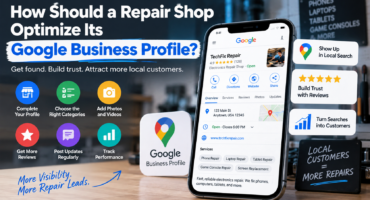
The website should also support the same priority services promoted through the Google Business Profile. That alignment is part of a stronger local search strategy.
Conversion Matters More Than Visual Novelty
A repair website should be judged by what visitors do after they arrive. Can they find the correct service quickly? Is the phone number visible? Can they request a quote without completing a long form? Are reviews and warranty details easy to find? Does the page explain what happens next?
A clean template that answers those questions can outperform a visually impressive custom site that makes the customer search for basic information.
This is also why repair shop website design should connect with lead management. If a visitor submits a quote request but nobody follows up, the website creates an opportunity while the business still loses the customer.
Mobile Speed and Maintenance Matter Either Way
Repair searches often happen on mobile devices and frequently involve urgency. Someone with a cracked screen, failed laptop, or console that will not turn on is unlikely to wait for an overloaded page to finish loading.
Both templates and custom websites can be fast or slow. Performance depends on how they are built and maintained. Oversized images, excessive plugins, third-party scripts, and poorly written code can affect either approach.
Maintenance should also be part of the decision. A custom site may depend on a specific developer for future changes. A well-supported template system may make new service pages and routine edits easier.
Think About Growth and Integrations
A repair shop may start with a simple website and later add locations, device sales, buyback campaigns, instant quoting, automated follow-up, or more advanced lead tracking.
The site does not need every future feature on day one, but it should have a realistic path for expansion. A template platform that already integrates with the shop’s lead-management tools can sometimes scale more efficiently than a custom website that requires new development for every change.
If the business already knows it needs specialized functionality that the platform cannot support, planning a custom build from the beginning may avoid rebuilding twice.
Which Option Is Better for Most Repair Shops?
For a typical local electronics repair shop, a professionally designed industry-specific template is often enough. It can provide the service-page structure, mobile usability, quote tools, trust elements, SEO foundation, and conversion paths the business needs without unnecessary custom development.
Custom design becomes more compelling when the shop can identify a specific technical, operational, or branding requirement that a proven template cannot meet well.
The decision should come down to function, not status. Choose the option that gives customers the simplest experience, supports the services you want to grow, works with your marketing, and can be maintained reliably.
Build the Website Around Repair Leads, Not Just Design
Repair Max Marketing builds repair shop websites around lead generation rather than design for design’s sake. Its website service uses professionally designed repair-industry templates that are mobile-friendly, SEO-ready, and integrated with quoting and lead-management tools, while custom builds are available for shops with specific functionality or design needs.
If you are deciding between a template and a custom website, start by identifying what your shop actually needs to turn more visitors into repair customers.
Book a consultation with Repair Max Marketing to review your current website, service structure, lead flow, and the best website approach for your repair business.