One of the most common questions repair shop owners ask is how long they need to invest in local SEO before they start seeing results.
There is no universal number of days because local SEO for repair shops does not work like turning on an advertisement. Improvements usually happen in stages as search engines process changes to the website, Google Business Profile, business listings, reviews, content, and overall local authority.
Some improvements can become visible within the first few weeks. Meaningful ranking movement may take several months, particularly in competitive markets. Stronger and more stable visibility usually develops as the business continues strengthening the signals that demonstrate what it does, where it operates, and why it is relevant to local customers.
Understanding those stages makes it easier to distinguish normal SEO progress from a strategy that needs to be changed.
Local SEO Starts With the Foundation
The first stage is usually cleanup.
Before trying to increase rankings, a repair business needs to make sure Google is receiving accurate and consistent information.
That begins with basics such as the correct business name, address, phone number, operating hours, website URL, Google Business Profile categories, and major repair services.
The website needs the same attention.
A shop offering phone repair, computer repair, MacBook repair, data recovery, tablet repair, and game console repair should make those services easy to understand. Important services may require dedicated pages rather than being mentioned briefly on one general services page.
Technical problems also need to be addressed early. Broken pages, incorrect redirects, duplicate URLs, indexing problems, poor mobile usability, and inconsistent business information can weaken the foundation before content or authority building even begins.
These fixes may not immediately move a shop into the top three Google Maps results, but they remove obstacles that can prevent later improvements from working properly.
The First 30 Days: Establishing Clear Local Signals
During the first month, the priority should be accuracy and relevance rather than expecting dramatic ranking changes.
This is when a local SEO campaign commonly addresses the Google Business Profile, website structure, service targeting, page titles, headings, internal links, local business information, and major citation inconsistencies.
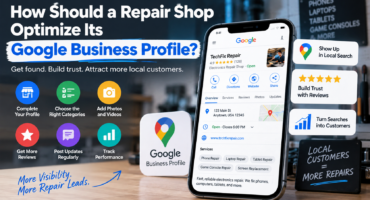
The Google Business Profile should accurately represent the services the shop genuinely provides. Categories should match the real business, and important services should be supported by the website.
For example, if a profile lists computer repair but the website has no meaningful computer repair page or section, strengthening that connection can help search engines better understand the business.
The first month is also a good time to establish reliable measurement.
Rankings, calls, website traffic, Google Business Profile interactions, form submissions, and direction requests should be tracked before major changes are judged.
Early progress may appear as better indexing, improved impressions, more relevant search queries, or pages beginning to rank even if they have not yet reached the first page.
Days 30 to 90: Building Relevance
Once the foundation is cleaner, the next stage is strengthening topical and local relevance.
This is where individual service pages become especially important.
A repair shop trying to compete for searches such as “iPhone repair,” “laptop repair,” “data recovery,” or “console repair” needs enough useful content for both customers and search engines to understand those services.
A good service page should explain what is repaired, common problems, supported devices, the diagnostic or repair process, the location served, and what the customer should do next.
Supporting content can then strengthen those core pages.
For example, an article about why a laptop will not charge can support a laptop repair page. A guide explaining signs of hard-drive failure can support a data recovery service. Content should build around the commercial pages rather than existing as an unrelated collection of blog posts.
During this period, rankings may begin moving more noticeably because Google has more information connecting the business with specific repair services.
Results can still vary considerably by keyword. A specialized service with weak local competition may improve faster than a broad term such as “phone repair near me.”
Months Three to Six: Building Authority
Relevance answers the question, “Does this business provide the service?”
Authority helps answer, “Why should this business appear above other local options?”
That takes longer to build.
Reviews are one important part of the process. A repair shop that consistently earns legitimate feedback from real customers demonstrates an ongoing history of serving the local market.
Reviews are also useful to potential customers because they often describe actual experiences with screen repairs, laptop problems, data recovery, console repairs, turnaround time, customer service, and other practical concerns.
Local citations and business listings contribute another layer. Accurate information across trusted platforms helps reinforce the business identity, particularly when a shop has previously changed its address, phone number, website, or business name.
The website can also build authority through stronger service coverage, useful supporting content, internal linking, and links or mentions earned from relevant websites and local organizations.
By this point, the objective is no longer merely fixing errors. It is developing stronger evidence that the repair shop is an established and relevant local business.
Six Months and Beyond: Ranking Stability and Expansion
Local SEO does not end when rankings improve.
Competitors continue earning reviews, publishing pages, updating their Google profiles, and strengthening their websites.
Once priority services begin performing well, the strategy can expand.
That may mean strengthening additional repair categories, improving visibility in nearby areas that the shop legitimately serves, building supporting content around valuable customer questions, or improving pages that rank just outside the strongest positions.
Performance should also become more stable over time.
A new page may initially move up and down while Google evaluates it. A mature service page supported by strong website structure, reviews, local signals, and ongoing engagement is more likely to maintain useful visibility.
The goal should therefore be sustained qualified traffic and leads rather than briefly reaching a particular ranking position.
What Can Make Local SEO Work Faster?
Some repair shops begin with a much stronger foundation than others.
A business with hundreds of legitimate reviews, an established domain, accurate listings, strong service pages, and years of local history may respond to optimization faster than a newly opened shop with almost no online presence.
Competition also matters.
Ranking for computer repair in a small market with only a few established competitors can be very different from competing for phone repair in a densely populated city with dozens of highly reviewed repair stores.
Other factors that can affect progress include:
- the quality of the existing website
- Google Business Profile completeness
- review quantity, quality, and consistency
- proximity to searchers
- strength of competing businesses
- website authority
- accuracy of citations
- service-page quality
- technical SEO issues
- how consistently improvements are implemented
No legitimate SEO strategy can control every one of these factors, particularly proximity and competitor activity.
What Can Delay Results?
One of the biggest causes of slow progress is trying to build on a weak foundation.
Creating several new articles will not compensate for an incorrect address or an unverified Google Business Profile.
Likewise, adding keywords to pages will not solve a website where multiple URLs compete for the same service.
Frequent unnecessary changes can also make evaluation harder. Constantly changing categories, URLs, page targeting, or Google Business Profile information prevents the business from establishing a stable structure.
Another problem is spreading resources too thin.
A repair shop may offer dozens of individual repairs, but trying to rank a separate page for every possible device problem can create weak, repetitive content. It is usually more effective to establish strong parent services first and expand only where separate search intent justifies it.
Do Not Judge Local SEO Only by Rankings
Rankings matter, but they are not the only early indicator of progress.
Before a repair shop reaches the top positions, several metrics may already show that the strategy is moving in the right direction.
Watch for increases in impressions for relevant service searches, organic visitors reaching priority pages, Google Business Profile interactions, calls, direction requests, form submissions, and appointment requests.
Search-query quality is also useful.
If a computer repair business begins appearing more often for laptop repair, SSD upgrade, data recovery, or MacBook repair searches instead of unrelated traffic, relevance is improving even before every keyword reaches its target position.
Conversions ultimately matter more than ranking reports.
A number-one ranking that generates no repair jobs is less valuable than several strong positions that consistently produce qualified calls.
A Realistic Local SEO Timeline
For most repair shops, local SEO should be viewed as a progression.
First 30 days: Correct the foundation, tracking, website structure, Google Business Profile, and major local inconsistencies.
Months two and three: Strengthen priority service pages, local relevance, internal linking, and supporting content.
Months three to six: Build authority through reviews, citations, content, stronger service coverage, and continued optimization.
Six months and beyond: Stabilize successful rankings, improve weaker services, expand carefully, and respond to changes in the local market.
These are stages rather than guarantees. Some opportunities can improve sooner, while highly competitive searches may require considerably more work.
Ready to Improve Your Repair Shop’s Local Visibility?
Local SEO takes time, but the right strategy should create measurable progress along the way.
If your repair shop is struggling to appear in Google Maps, rank for important repair services, or turn local search visibility into more calls and bookings, Repair Max Marketing can help.
We build local SEO for repair shops around the parts that matter most: Google Business Profile optimization, service-page structure, keyword targeting, local citations, reviews, technical SEO, supporting content, and conversion tracking.
The goal is not simply to increase rankings. It is to help more nearby customers find your shop when they are actively searching for the repairs you provide.
Book a consultation with Repair Max Marketing and let us review your website, Google Business Profile, local rankings, and biggest opportunities for growth.