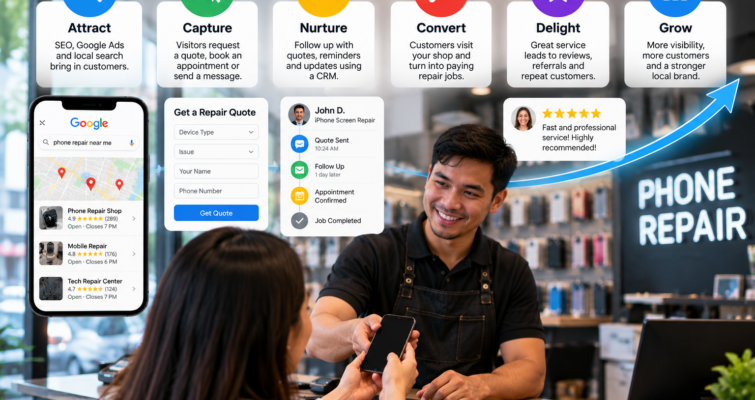
A complete repair shop marketing funnel is more than running ads or posting on social media. It is the path a customer takes from first discovering the shop to requesting a quote, booking a repair, becoming a paying customer, and potentially returning or recommending the business later.
For electronics repair businesses, that path can move quickly. Someone may crack an iPhone screen in the morning, search Google at lunch, compare reviews and prices on a phone, and choose a shop the same day. A strong funnel supports that behavior without adding unnecessary steps.
The goal is to connect visibility, landing pages, lead capture, follow-up, conversion tracking, and retention so good opportunities do not disappear between stages.
Start With the Repair Services You Want to Grow
Before choosing channels, identify the repair jobs the business actually wants more of. Phone repair, MacBook repair, data recovery, tablet repair, and console repair can have very different demand, margins, turnaround times, and staffing requirements.
A complete funnel should prioritize services the shop can deliver well and profitably. That choice affects which keywords to target, which pages to build, which ads to run, and which leads should receive the fastest follow-up.
This prevents the common mistake of treating traffic volume as the main goal. Fewer qualified customers looking for profitable repairs can be more valuable than large amounts of low-intent traffic.
Stage One: Get Found Where Repair Customers Search
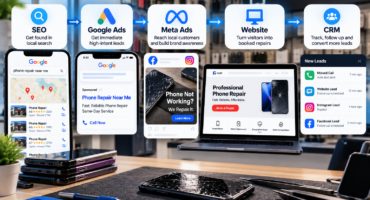
The top of the funnel is about visibility. For most local repair shops, important discovery channels include Google Search, Google Maps, paid search, and local brand visibility.
A strong Local SEO strategy helps the business appear for relevant searches over time through Google Business Profile optimization, service-page relevance, reviews, citations, and website authority. Paid search can complement that by placing the shop in front of high-intent customers more quickly.
The funnel should recognize intent. Someone searching “iPhone screen repair near me” is showing stronger immediate buying intent than someone casually scrolling social media.
Stage Two: Send the Click to the Right Page
Visibility only creates an opportunity. The landing experience determines whether the visitor takes the next step.
A customer searching for MacBook repair should not land on a generic homepage and then hunt for the service. The page should confirm the repair, explain what the shop handles, show trust signals, and make the next action obvious.
A conversion-focused repair shop website should be structured around real service intent with strong service pages, fast mobile performance, clear calls to action, and accurate location information.
Stage Three: Make Quotes and Booking Easy
Once a visitor is interested, the funnel should reduce friction. Customers should not need to search for a phone number, complete a long form, or wait hours for a basic answer if the repair can be quoted quickly.
For predictable services, instant quoting can help a customer select a device and repair type, receive an estimate, and move toward booking or contact. For liquid damage, motherboard faults, data recovery, or other complex work, the site can explain that diagnostics are required.
The goal is not to automate every repair. It is to give each customer the clearest appropriate next step.
Stage Four: Capture and Organize Every Lead
Many repair shops lose opportunities after the customer makes contact. Calls are missed, quote requests sit in an inbox, forms are answered too slowly, or staff do not know who followed up.
A repair shop CRM can organize leads from forms, quotes, calls, messages, and campaigns so the team can see who is new, who has been contacted, who booked, and who still needs follow-up.
Lead tracking should not stop at “a form was submitted.” The real business outcome is whether that lead became a booked and completed repair.
Stage Five: Follow Up Before the Customer Goes Elsewhere
Repair customers often contact more than one shop. Speed and clarity can influence who wins the job.
A good follow-up process may include missed-call text-back, quote reminders, appointment confirmations, or a personal response when the customer has a more complicated question. Automation can improve consistency, but it should not make the experience feel impersonal or misleading.
The best systems automate routine communication while still giving staff the context needed to step in when a real conversation is required.
Stage Six: Capture High-Intent Demand With Google Ads
Paid search can be one of the most direct middle- and bottom-funnel channels because the customer is actively searching for a repair service.
A strong Google Ads campaign for repair shops should focus on services the shop actually wants, commercial-intent keywords, relevant geographic targeting, useful negative keywords, matching landing pages, and reliable conversion tracking.
Clicks alone are not enough. The shop should know which campaigns produce calls, quote requests, bookings, and ultimately paying repair jobs so budget can move toward real revenue.
Stage Seven: Build Trust Before Asking for the Sale
Repair customers are handing over valuable devices and sometimes sensitive personal data, so trust is part of the funnel.
The website and Google Business Profile should reinforce credibility with genuine reviews, accurate business information, real photos, clear service details, warranty information where applicable, and transparent expectations around estimates or diagnostics.
Avoid exaggerated claims that cannot be supported. E-E-A-T is better demonstrated through real expertise, accurate information, a clear business identity, and content that reflects how the repair process actually works.
Stage Eight: Track the Funnel From Click to Paying Job
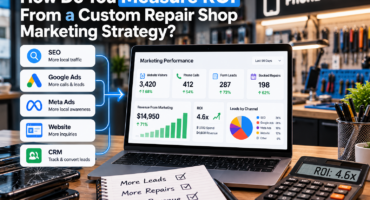
A complete marketing funnel needs measurement at each important stage. That includes impressions and clicks, but also calls, form submissions, quote requests, appointments, show-ups, approved repairs, completed jobs, and revenue when the shop can track it reliably.
If a campaign generates twenty leads but only two become paying jobs, the shop needs to know whether the problem is targeting, pricing, lead quality, follow-up, availability, or the sales process.
Tracking the full customer journey gives the business a better answer than simply asking whether traffic or lead volume increased.
Stage Nine: Turn Completed Repairs Into Future Growth
The funnel should not end when the customer pays. A completed repair can lead to a review, referral, repeat visit, or another service later.
After a successful job, the shop can request honest feedback, keep customer communication organized, and make it easy for the customer to return when another device needs service.
Reviews can also strengthen trust for future prospects and support local visibility, allowing completed repairs to help generate the credibility needed to win new customers.
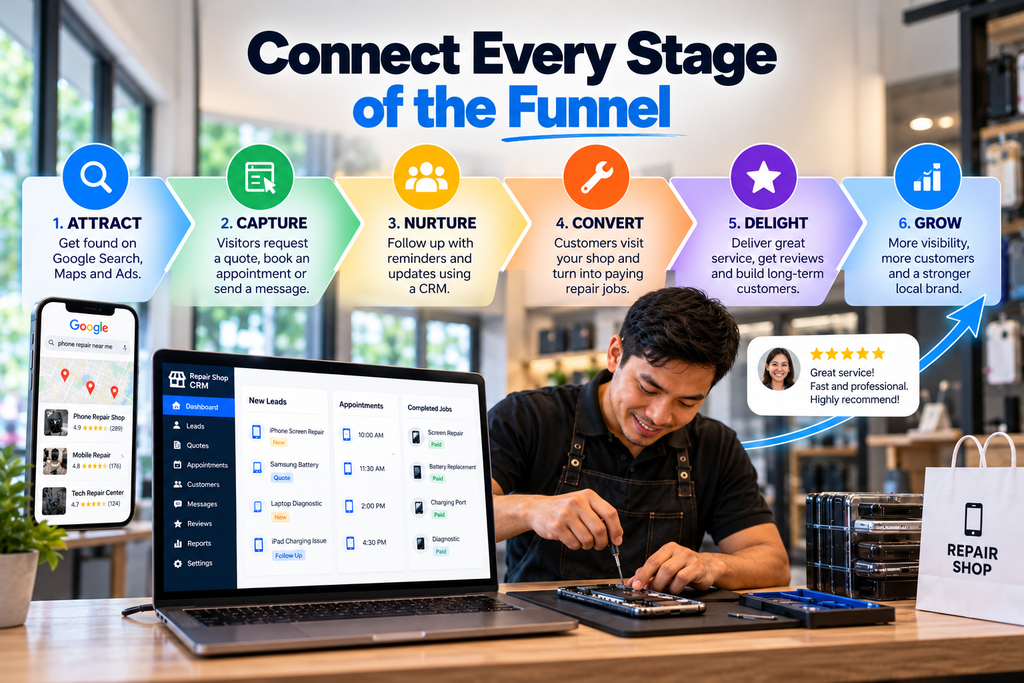
Connect Every Stage of the Funnel
The biggest weakness in many repair shop marketing systems is not the absence of one channel. It is the lack of connection between them. Ads may generate leads nobody follows up with. SEO may produce traffic that lands on weak pages. A good website may generate quotes without a system for tracking whether they became jobs.
A complete funnel connects discovery, landing pages, quote or booking tools, lead management, follow-up, conversion tracking, reviews, and retention around the services the business actually wants to grow.
Repair Max Marketing helps electronics repair businesses connect these pieces through websites, Local SEO, Google Ads, instant quoting, and CRM systems designed around the repair customer journey.
Contact Repair Max Marketing to review where your current marketing funnel is losing opportunities and what should be improved first.