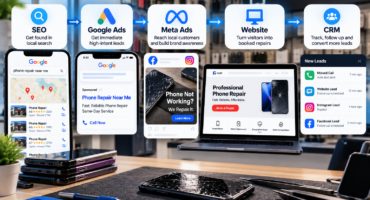
A repair shop website has two jobs: help the business appear when nearby customers search for repair services, and make it easy for those customers to take action once they land on the site. Ranking without conversion can produce traffic that never becomes revenue. Conversion without visibility leaves a strong website hidden from the people who need it.
The strongest approach connects Local SEO for repair shops with a mobile-first customer experience. That means clear service pages, accurate local business information, a well-optimized Google Business Profile, fast loading, useful trust signals, and calls to action that work well on a phone.
There is no single element that guarantees local rankings. Google evaluates local results through factors such as relevance, distance, and prominence, while the website still needs to satisfy the customer once they arrive.
Build the Website Around the Services Customers Search For
A repair shop should not rely on one homepage to rank for every service it offers. If the business repairs iPhones, Samsung phones, laptops, MacBooks, tablets, game consoles, and storage devices, the website needs enough structure for customers and search engines to understand those services.
That does not mean creating a thin page for every device model or repair symptom. Pages should be built around distinct search intent. A strong phone repair page, laptop repair page, MacBook repair page, data recovery page, or console repair page can support an important service category when the content genuinely explains what the shop does.
Each page should answer practical questions: what is repaired, common problems handled, who the service is for, where it is available, and what the customer should do next.
Use Location Pages Only for Real Locations
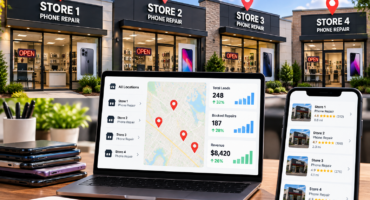
A repair business with multiple staffed locations may need a dedicated page for each one, especially when each has its own address, hours, phone number, reviews, or service details.
A single-location shop should not manufacture dozens of nearly identical city pages simply to target every nearby suburb. Those pages can add little value and create unnecessary duplication.
The better approach is to build strong service pages, identify the real shop location clearly, and naturally explain nearby areas customers commonly travel from when that information is useful.
Align the Website With the Google Business Profile
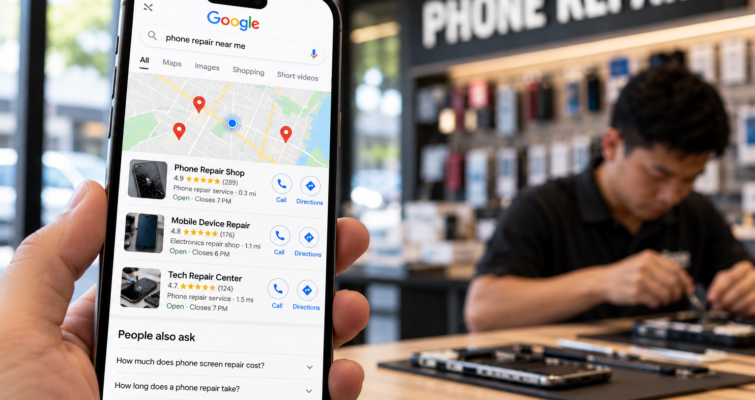
For many repair shops, the Google Business Profile may appear before the website in a local search. The profile and website should therefore tell the same story.
If the profile lists computer repair, console repair, and data recovery, the website should support those services. If the website shows a new address or phone number, the profile should not display outdated information.
Review the business name, address, phone number, hours, services, categories, and website link for consistency. A complete Google Business Profile optimization helps Google and customers understand the business more clearly.
Reviews and accurate business mentions across relevant directories also support a stronger local presence. That is why reviews and local citations should be managed as part of the same local SEO system.
Make Mobile Speed and Usability a Priority
Repair searches are often urgent and frequently happen on a phone. A customer with a cracked screen or a console that stopped working may not wait for a slow page, fight through a large pop-up, or zoom in to find a phone number.
Mobile performance starts with a responsive layout, optimized images, sensible scripts, stable page elements, and fast hosting. But technical speed is only part of the experience. A page can load quickly and still be difficult to use if the call button is hidden or the form requires too many steps.
A strong repair shop website should make the primary next step visible. Tap-to-call, quote, booking, directions, and contact options should be easy to use on a small screen.
Match the Landing Page to Search Intent
A visitor searching for “iPhone screen repair near me” should not land on a generic page that only says the shop fixes electronics. The page should immediately confirm that the service is offered and provide enough information to move forward.
Headings, page copy, internal links, images, and calls to action should support the same intent. Keyword use should be natural. Repeating the city and service phrase in every paragraph does not make the page more helpful.
Put Trust Signals Near the Decision
Repair customers are handing over expensive devices and often personal data, so trust matters. Mobile pages should show credible proof near the points where customers decide whether to call or book.
Useful trust signals include genuine reviews, warranty information when applicable, real photos of the shop, clear business details, service explanations, and transparent expectations about estimates or diagnostics.
Avoid unsupported claims such as being “authorized” or “number one” unless they can be substantiated. E-E-A-T is strengthened by accuracy, first-hand business information, clear expertise, and a site that reflects the real repair process.
Reduce Friction With Quotes and Booking
Mobile visitors often want a fast answer. If a common repair has predictable pricing, an instant quote can help a customer move from browsing to action without waiting for a manual reply.
For services that require inspection, the site can explain that diagnostics are needed and offer a booking or contact option instead. That is more credible than pretending every repair can be priced automatically.
Repair Max Marketing’s guide to instant quoting for repair shops explains how a quote tool can reduce friction, prequalify leads, and connect customers to the next step.
Use Internal Links to Reinforce the Site Structure
Internal links help customers discover related services and help search engines understand how pages connect. A phone repair page may naturally link to iPhone repair or screen repair. A data recovery article may link to the main data recovery service page.
Internal linking should be useful rather than mechanical. The anchor text should describe what the visitor will find, and priority service pages should not be buried several clicks deep.
Track Rankings and Conversions Together
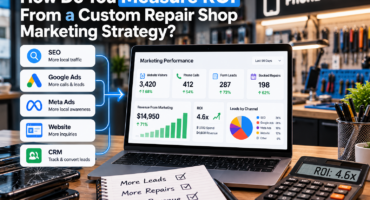
A repair shop should not judge website performance by rankings alone. More impressions and higher positions are useful only if the right customers reach the site and take meaningful actions.
Track organic visibility alongside calls, quote requests, appointment bookings, form submissions, direction requests, and completed repair jobs when possible.
If a page ranks but produces few leads, review search intent, mobile usability, trust signals, and the call to action. If a page converts well but receives little visibility, the issue may be relevance, internal linking, authority, content depth, or competition.

Build for Local Visibility and Customers at the Same Time
The best local repair websites are not built for an algorithm first and customers second. They make the real business easy to understand, easy to find, and easy to contact.
That means creating meaningful service pages, representing real locations accurately, aligning the site with the Google Business Profile, maintaining consistent local information, earning genuine reviews, improving mobile performance, and reducing friction in the conversion process.
Repair Max Marketing builds websites and local SEO systems specifically for electronics repair businesses, with site structure, mobile lead capture, quoting, Google Business Profile alignment, and local visibility designed to work together.
Contact Repair Max Marketing to review whether your repair shop website is structured to rank locally and turn more mobile visitors into repair customers.