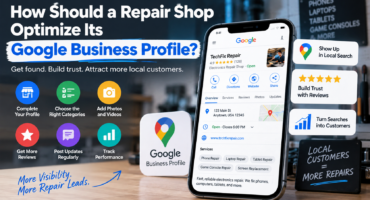
If your repair shop is not appearing on Google Maps, the problem is not always a lack of reviews or SEO work. Visibility can disappear or remain weak for several different reasons, ranging from an incomplete Google Business Profile to category problems, verification issues, weak local relevance, or increased competition.
For a repair business, Google Maps visibility matters because many customers search when they already need help. Someone looking for phone repair, computer repair, data recovery, console repair, or a nearby electronics repair shop may choose from the businesses displayed in the local results without ever scrolling far down the traditional search results.
When a repair shop is not showing on Google Maps, the best approach is to diagnose the problem in order rather than changing multiple profile elements at once.
Start by Confirming the Business Is Eligible
Before looking at rankings, confirm that the business qualifies for a Google Business Profile.
A repair shop with a storefront where customers can visit during stated business hours will generally fit the normal local-business model. Service-area repair businesses can also be eligible when they travel to customers, provided the profile is configured correctly.
Problems can occur when the address represents a virtual office, mailbox, temporary space, or another type of location that does not meet Google’s requirements for the business model being represented.
This matters because no amount of keyword optimization can overcome an underlying eligibility issue.
Repair businesses that have recently moved, changed ownership, opened an additional location, or switched from a storefront to a service-area model should pay particular attention to this step.
Check Verification and Profile Status
Next, determine whether the profile is actually verified and active.
A business may appear complete from the owner’s perspective but still require verification or additional action. Google may occasionally request reverification after significant changes, such as editing an address or other important business information.
Check the profile directly while signed into the account that manages it.
Look for warnings, verification prompts, disabled features, requests for additional information, or notices that changes are still being reviewed.
If the profile is not verified, visibility will be limited until the required verification process is completed.
If verification was previously completed but the shop suddenly stopped appearing, investigate whether recent profile edits triggered another review.
Review the Primary Category
Categories are one of the clearest ways to tell Google what type of business you operate.
A repair shop should choose the primary category that most accurately describes its main business.
Depending on the shop, that may be something such as a mobile phone repair shop, computer repair service, or electronics repair shop.
The choice should reflect the business’s actual primary service rather than whichever category sounds broadest or contains the most keywords.
For example, a business that primarily repairs phones should not select a computer-focused primary category simply because it also handles laptops occasionally.
Secondary categories can support additional legitimate services, but adding unrelated categories does not make the profile more powerful. It can instead make the business less clearly defined.
If rankings are weak for the services that matter most, category selection should be one of the first elements reviewed.
Understand the Role of Proximity
Local rankings are different from traditional organic rankings because the searcher’s physical location matters.
A repair shop can rank strongly for someone two blocks away and barely appear for someone several miles across the city.
That does not automatically mean something is wrong with the profile.
Google Maps results are heavily influenced by the relationship between the searcher and businesses that are relevant to that search. Dense cities can make this particularly noticeable because customers may have many repair shops within a relatively small radius.
This is why manually searching one keyword from the shop itself is not enough to accurately judge local visibility.
A repair business should evaluate rankings across different points in its target area instead of assuming that one search represents the entire market.
Make Sure Google Understands What You Repair
Proximity alone is not enough. Google also needs to understand why the business is relevant to a particular search.
If the profile simply says “electronics store” while the business actually offers iPhone repair, tablet repair, computer repair, MacBook repair, game console repair, and data recovery, the profile may not communicate enough service depth.
The Google Business Profile should accurately reflect the major services the business genuinely provides.
The website should reinforce the same information.
If the profile promotes computer repair but the website has no meaningful computer repair content, that creates a weak connection. If the website has a strong game console repair page but the profile never mentions that service, another opportunity is being missed.
A strong local presence usually comes from consistent signals rather than a single optimized field.
Review the Website Behind the Profile
Google Maps optimization should not be separated from website SEO.
The website connected to the profile should clearly state the business name, services, location, phone number, and important repair categories.
Dedicated service pages can help establish relevance for major searches.
For example, a repair business may have pages for:
- Phone repair
- iPhone repair
- Computer repair
- Laptop repair
- MacBook repair
- Tablet repair
- Game console repair
- Data recovery
Those pages should not simply repeat the same generic copy with different keywords. Each should explain the specific service, devices covered, problems handled, location, and next step for the customer.
Weak website architecture can make it harder for search engines to understand which services the shop specializes in.
Check NAP Consistency
NAP means name, address, and phone number.
These details should remain consistent across the website, Google Business Profile, important directories, social platforms, and major public listings.
This becomes particularly important after a rebrand, relocation, or phone-number change.
Imagine a shop using one business name on Google Maps, an older name on several directories, a previous address on Facebook, and an outdated phone number on its website footer.
Those inconsistencies create unnecessary ambiguity.
They may not always cause an immediate ranking loss on their own, but cleaning them up strengthens the overall local-business identity and prevents customers from encountering conflicting information.
Reviews Affect More Than Star Rating
Reviews help prospective customers choose a repair shop, but they also contribute to the business’s overall local prominence.
A business with a steady history of legitimate customer reviews generally presents a stronger local trust profile than one with very little customer feedback.
Quantity is not the only consideration.
Recency, review quality, owner responses, and the natural language customers use can all provide useful context about the business.
A customer describing a successful iPhone screen replacement, laptop repair, data recovery job, or console repair gives future customers much more useful information than a one-word review.
Repair shops should ask satisfied customers for honest reviews without scripting what they should write or offering prohibited incentives.
Competition May Have Changed
Sometimes a repair shop has not done anything wrong.
The market simply became more competitive.
Another shop may have improved its website, earned more reviews, strengthened its service pages, optimized its Google Business Profile, or opened a location closer to an important search area.
This is why a shop that previously appeared in the top three results can gradually move lower even though its own profile has not changed.
Local SEO is competitive.
Visibility should therefore be evaluated relative to the businesses appearing above you.
Look at their categories, reviews, locations, websites, service coverage, content depth, and overall local presence.
The objective is not to copy competitors. It is to understand what Google is currently rewarding in that local market and identify where your own business is weaker.
Check for Suspensions and Policy Problems
If visibility disappeared suddenly rather than gradually, check for a profile restriction or suspension.
A suspended profile is different from a shop simply ranking poorly.
Warning signs may include losing management functionality, receiving policy notifications, being asked to verify information again, or disappearing from Maps despite previously having normal visibility.
Avoid immediately creating a second profile.
Duplicate profiles can make the situation more complicated.
Instead, review recent edits and verify that the business name, address, categories, website, phone number, and business model accurately represent the real business.
If Google provides a path to correct the issue or submit an appeal, address the underlying problem before requesting reinstatement.
Follow This Order When Diagnosing Google Maps Visibility
When a repair shop is not showing on Google Maps, work through the problem in this order:
- Confirm eligibility. Make sure the business model and address meet the requirements for a local profile.
- Check verification. Look for pending verification or reverification requests.
- Review profile status. Check for warnings, restrictions, or suspension notices.
- Verify the primary category. Make sure it reflects the shop’s most important real-world service.
- Review services and profile information. Clearly represent what the business actually repairs.
- Check proximity. Test visibility from multiple areas instead of relying on one search.
- Audit the website. Make sure priority repair services have strong, relevant pages.
- Correct NAP inconsistencies. Clean up outdated names, addresses, and phone numbers.
- Review reputation signals. Continue generating genuine customer reviews and responding to them.
- Assess local competition. Determine whether nearby competitors have strengthened their local presence.
- Track rankings over time. Measure improvement rather than making repeated profile changes based on individual searches.
Fix the Foundation Before Chasing Rankings
When a repair shop is not showing on Google Maps, there is rarely one universal fix.
The issue could be eligibility, verification, categories, proximity, weak service relevance, poor website support, inconsistent business information, stronger competition, or a profile restriction.
The most effective approach is diagnostic.
Start by making sure Google can verify who the business is, where it operates, and what it actually repairs. Then strengthen the website, profile, reviews, local listings, and service signals supporting that information.
A well-optimized Google Business Profile works best when the rest of the business’s online presence tells the same story. When those signals are accurate and consistent, the repair shop has a stronger foundation for improving visibility across Google Maps and local search.
Need Help Improving Your Google Maps Visibility?
If your repair shop is struggling to appear in Google Maps, rank for important repair services, or compete with nearby businesses, Repair Max Marketing can help.
We work specifically with electronics repair businesses and help strengthen the areas that influence local visibility, including Google Business Profile optimization, service-page structure, Local SEO, citations, reviews, website signals, and ongoing search performance.
Want to know what may be holding your repair shop back?
Book a consultation with Repair Max Marketing and let us review your Google Business Profile, website, local rankings, and biggest opportunities for improvement.