
A repair shop may offer dozens of services and serve several nearby areas, but that does not mean every repair type or city needs its own website page. Creating too many pages can make the site harder to manage and may cause several URLs to compete for the same search intent.
A stronger approach is to create pages only when there is a clear reason for them to exist. For local SEO, that means looking at customer intent, search demand, business priorities, and whether the page can provide genuinely useful information.
This is an important part of local SEO for repair shops because website structure affects how clearly customers and search engines understand the business.
Not Every Repair Service Needs a Separate Page
Repair shops may provide cracked-screen repair, battery replacement, charging-port repair, liquid-damage repair, motherboard work, data recovery, software help, and many other fixes. Some deserve dedicated landing pages. Others are better covered inside a broader service page.
The deciding factor should be search intent, not the length of the service list.
Phone repair, computer repair, MacBook repair, game console repair, and data recovery can represent different customer needs. Each may justify its own page when the service is important to the business and has enough demand. By contrast, a phone repair page can often cover screens, batteries, charging issues, cameras, speakers, and other common symptoms without creating a separate URL for every problem.
Create a Service Page When the Search Intent Is Distinct
A dedicated service page makes sense when the search represents a meaningful commercial need and the business can provide enough useful information to satisfy it.
A data recovery page can explain storage failures, inaccessible files, diagnostic steps, limitations, and what customers should expect. That content is different from a general computer repair page. The same logic may apply to iPhone repair, Android repair, MacBook repair, or other priority services when the intent is clearly different.
If two pages would answer almost the same question with almost the same content, they probably should not both exist.
Avoid Keyword Cannibalization Between Similar Pages
Too many overlapping pages can make several URLs compete for the same keyword and customer.
A shop might have pages called Computer Repair, Computer Repair Services, PC Repair, and Desktop Computer Repair. If all of them target essentially the same intent, authority and internal links become spread across several weaker pages instead of one strong page.
Website architecture should therefore be planned before more pages are added. Repair Max Marketing’s website service focuses on lead generation and repair-industry structure rather than adding pages simply to make a site larger.
Use Parent Pages and Subpages When the Hierarchy Is Clear
A repair shop website often works best with broader parent services supported by selected subpages.
Phone Repair can act as the main page, while iPhone Repair and Android Repair sit underneath it when those searches are important enough to justify separate pages. Computer Repair can support Laptop Repair, MacBook Repair, or Data Recovery where the intent is distinct.
Internal links should reinforce the hierarchy. A cracked iPhone article should support the iPhone repair page. A guide about failing hard drives should support data recovery. The goal is to build useful topic clusters rather than isolated pages.
Does Every City or Service Area Need Its Own Page?
No. A repair shop should not automatically create a landing page for every city, suburb, neighborhood, or ZIP code it wants to reach.
Location pages are strongest when they represent a real store or when there is enough meaningful local information to create a genuinely useful page for customers in that area.
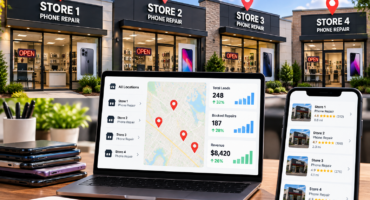
If a business has multiple physical stores, each location normally deserves its own page with the correct address, phone number, hours, map, directions, services, and local calls to action. A single-location shop may serve nearby communities, but dozens of near-identical city pages with only the place name changed provide little value.
A Location Page Needs More Than a City Name
A useful location page should explain why the business is relevant to customers in that area.
For a physical shop, that can include business information, directions, parking details, nearby landmarks, store photos, service availability, and appointment information. For a service-area business, the content should clearly explain how the company serves that location without pretending to have a storefront where none exists.
The website should also stay aligned with the Google Business Profile. Repair shops can use How Should a Repair Shop Optimize Its Google Business Profile? as a guide for categories, services, location information, reviews, and website support.
Service Pages and Location Pages Solve Different Problems
A service page answers, ‘Can this shop perform the repair I need?’ A location page answers, ‘Can this business serve me here?’ Those are different questions.
Trying to combine every service with every city can create hundreds of URLs. For most independent repair businesses, that level of expansion is unnecessary and creates a major content-quality burden.
Build the strongest core service pages first. Then strengthen the actual location page or pages. Expand only when the business has a legitimate opportunity that cannot be served well by the existing structure.
What Should a Repair Shop Evaluate Before Creating a New Page?
Before adding a service or location URL, ask whether the page serves a distinct customer need, whether people genuinely search for it, and whether the business can provide enough unique information to make the page useful.
Check whether an existing page already covers the intent. Improving that page may be more valuable than creating another. Also consider business value: a profitable data recovery service may deserve more attention than a low-volume repair that happens only occasionally.
A new page should make it easier for someone to understand the service, trust the business, and take action. It should not exist only because a competitor has a similar URL.
Build Pages Around Real Search Intent, Not Page Count
A larger website is not automatically a stronger website.
The best structure gives each important service a clear home, keeps related topics connected, and avoids unnecessary duplication. The same principle applies to locations: create pages where there is genuine local value, not simply because the shop wants to rank in every nearby city.
If a shop is struggling with local visibility, the issue may be service targeting, Google Business Profile alignment, reviews, proximity, or other local signals rather than a lack of pages. Our guide on why a repair shop may not be showing up on Google Maps covers the other factors that should be checked before expanding the site.
Need Help Planning Your Repair Shop Website Structure?
Repair Max Marketing works specifically with electronics repair businesses and can help determine which services need dedicated landing pages, which topics should remain grouped together, and where location pages make sense.
The goal is not to create the most pages. It is to build a structure that supports search visibility, customer understanding, and lead generation without unnecessary overlap.
Contact Repair Max Marketing to review your current service pages, location strategy, Local SEO opportunities, and the areas where your website structure can be improved.